

At Day & Knight, we strive to keep our customers and the local community safe, both through our quality of work and by raising awareness on electrical safety in homes and workplaces.
A vital part of domestic electrical installation regulations is Part P of the Building Regulations. We’ve put together this guide to help answer your questions on:

What are Part P of the Building Regulations?
These regulations were introduced in 2005 by the Government to include electrical safety rules as part of the Building Regulations for England and Wales. Since its introduction in 2005, there have been additional changes added for England in 2013 to ensure electrical compliance.
These regulations apply to dwellings only and generally do not apply to commercial properties, as these are regulated under different legislation, such as the Electricity at Work Regulations 1989.
Why Part P of the Building Regulations Are Important
Because of the nature of electrical work, it poses risks to people and homes if it is not installed or updated correctly. The regulations aim to keep you and your family free from electrical hazards, including:
- Faulty wiring or overloaded circuits can cause electrical fires
- Unsafe installations from unqualified electricians can lead to electric shocks or even worse, electrocution
- Damage to property from appliances that overheat or produce sparks
- Unsafe alterations to existing electrical work by electricians with insufficient knowledge or testing
Additionally, these regulations also ensure that electrical work is notified to local authorities and building control so official documentation and compliance records can be created. Part P also actively encourages landlords and homeowners to use a qualified, registered electrician to complete all electrical work – more details below.
What Electrical Work Is Covered by These Regulations
“Since 2005, all electrical work in dwellings in England and Wales, whether carried out professionally or as DIY, must meet the requirements of Part P of the Building Regulations”.
The above definition is referenced as follows:
Electrical Competent Person Scheme Operators Ltd (2026) Building Regulations explained. Available at: https://www.electricalcompetentperson.co.uk/building-regulations-explained (Accessed: 07/03/2026).
The electrical work that is covered under Part P of Building Regulations is known as ‘notifiable work’ and must be notified to local authorities and building control.
For England and Wales this differs a little but by law, it is the homeowners’ and landlords’ responsibility to ensure all electrical work meets Part P of the Building Regulations. They must also be able to prove that the work completed adheres to these regulations – this a criminal offence if not followed correctly.
In the shortest of terms, this is:
“All electrical installation work in a home, garden, conservatory or outbuilding must meet the Building Regulations”.
The above definition is referenced as follows:
Electrical Safety First (2026) Part P of the Building Regulations. Available at: https://www.electricalsafetyfirst.org.uk/find-an-electrician/part-p/ (Accessed: 07/03/2026).
What is Notifiable Electrical Work in England?
Below is the scope of what constitutes notifiable work in England (this is slightly different in Wales):
“…Electrical work in a dwelling, or associated with its surroundings, is notifiable to a local building control body where it includes:
- circuit alteration or addition in a special location*
- installation of one or more new circuits
- installation of a replacement consumer unit (fuse box)
- rewire of all circuits
- partial rewire
- new full electrical installation (new build)
* Certain zones within a room containing a bath or shower, or a room containing a swimming pool or sauna heater.
An alteration or addition to an existing circuit in a room containing a bath or shower is notifiable only where carried out in the space surrounding a bath or shower shown below:”
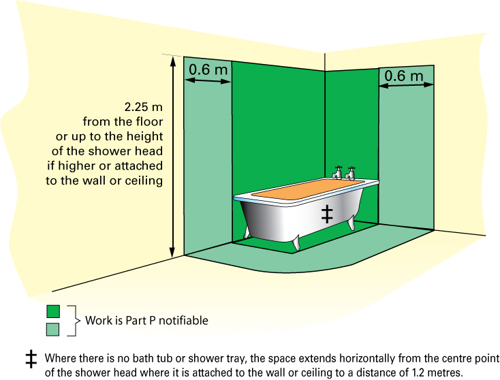
The above information and illustration has been taken from:
Electrical Competent Person Scheme Operators Ltd (2026) Building Regulations explained. Available at: https://www.electricalcompetentperson.co.uk/building-regulations-explained (Accessed: 07/03/2026).
If you believe that the work you’re undertaking is classified as non-notifiable work (not subject to notification under the Building Regulations), we would still recommend that you enlist a qualified, registered electrician to complete any electrical work. Although this isn’t required as part of the regulations, it can ensure your safety.
Who Can Confirm Electrical Work Is Part P Compliant?
Only electricians who are registered with a Government-approved scheme or a local authority’s building control can certify electrical work that is Part P compliant. It is essential to ensure electrical work is carried out by individuals or companies that have the proper knowledge, skill, experience and are correctly accredited.
With a qualified electrician, they are able to self-certify their own work for electrical compliance. All work completed by people who are not registered with a Competent Person Scheme must be inspected by the local authority’s building control.
You can check if your electrician is registered with a Government-approved scheme and get advice here – https://www.electricalcompetentperson.co.uk/choosing-an-electrician/
What Are Competent Person Schemes?
A Competent Person Scheme is an electrician who is registered with a Government-approved scheme provider such as NICEIC (National Inspection Council for Electrical Installation Contracting) or NAPIT (National Association of Professional Inspectors and Testers).
It’s worth mentioning that for an electrician to be registered with the above schemes, they must also hold qualifications like BS 7671 (18th Edition), Level 3 Inspection & Testing, and a Level 3 NVQ in Electrical Installations. An electrician without these registrations is unlikely to be able to sign off on and be compliant with Part P of the Building Regulations.
How to Get Part P Certification for Electrical Compliance
Once you have found a qualified, registered electrician to complete the notifiable work, you’ll need to make sure you have the correct certification once the job has been completed. To confirm that the work complies with Part P, the registered electrician will arrange for you to receive a Building Regulations Compliance Certificate. This is usually sent within 30 days of the job being completed.
They must also issue a safety certificate, as this will confirm the work meets BS 7671 Requirements for Electrical Installations standards. The additional electrical safety certificate should be an Electrical Installation Certificate (EIC) or a Minor Electrical Works Installation Certificate (MWC). This reaffirms that the electrician’s work is designed, inspected and tested in line with current standards.
Don’t forget – the landlord or homeowner is required to prove that all electrical work completed meets Building Regulations and BS 7671.
What happens if I don’t comply with Part P of the Building Regulations?
There are serious consequences of not complying with Part P of the Building Regulations. As this is a criminal offence, it can lead to the following consequences:
- Legal action: Extreme cases of violations could lead to imprisonment of up to 2 years, with the local authorities being able to prosecute both homeowners and electricians
- Financial penalties: You can face a fine of up to £5,000 per offence, or under the Building Safety Act 2022, this can escalate to unlimited fines
- Removal or rectification of work: Local authorities can demand that all non-compliant electrical work be removed or fixed
- Issues upon selling your property: Without the correct certification, such as a valid Electrical Installation Certificate (EIC) or Building Regulation Compliance Certificate, it can make it extremely difficult to sell your home, as buyers and solicitors will want proof of those.
- Invalidate your home insurance: If the worst happens and uncompliant work leads to a fire or injury in your home, your home insurance policy may be invalid, as the electrical work is not up to code. It is your responsibility as a homeowner or landlord to ensure all electrical work is safe and compliant.
Day & Knight are NICEIC certified and should be your go-to Part P electrician in Staffordshire. We pride ourselves on being a Part P-compliant electrician to help landlords and homeowners comply with electrical building regulations in Stafford and the surrounding areas.
You can use our Quick Quotes Form below or contact us today to confirm you’re Part P compliant.
Get your fast & Free quote hereFrequently Asked Questions
Part P of the Building Regulations was introduced in 2003 and later updated in 2013 to ensure electrical safety in all dwellings in England and Wales.
You can check if your electrician is qualified and registered by heading to the Electrical Competent Person website. You can also see our results and that we’re listed on the Electrical Competent Person website here.
Yes, it is a criminal offence if homeowners and landlords do not follow these regulations. We would always recommend you hire a certified electrician for electrical installations and request an electrical installation certificate upon completion.
An Electrical Installation Certificate (or EIC for short) is an official document that can be issued by a qualified, registered electrician to confirm that the work they have completed complies with BS 7671 Requirements for Electrical Installations.
If you have added, altered or extended any fixed electrical installations since January 1st 2005, then you will need a Part P Building Regulations Compliance Certificate. You can also use an Electrical Installation Certificate (EIC) to prove the work is safe and legal, as it is general practice for buyers or solicitors to request this before purchase. You can also get an Electrical Installation Condition Report (EICR) to confirm this.